My current project at work has me emailing every country in the world to ask them questions about their nurse laws.
It’s a very cool project, but it presents a couple challenges, the obvious one being that I can’t always rely on the person on the other end being able to understand English.
We’ve had our materials translated into a dozen languages at this point, and for most of them (Spanish, Portuguese, French) I’ve had enough exposure to at least be able to look at it and know that what it says is roughly comparable to the English. For some, though (Russian, Mandarin, a language called Hausa that I didn’t even know existed) I’m just blindly sending out an incomprehensible (to me) professionally translated questionnaire with introductory message, and praying that they don’t write back asking for help. Because in those languages, all I can do to reply is plug something into Google Translate and trust that it really does say “thank you for your message” and not “I admire your orange.”
The one exception to this is German. Due to previous, unconventional educational decisions, this is the one language where, when someone writes back asking if they can get back to me after their Easter holiday, I can respond “Of course, I look forward to your response” without the assistance of an internet robot.
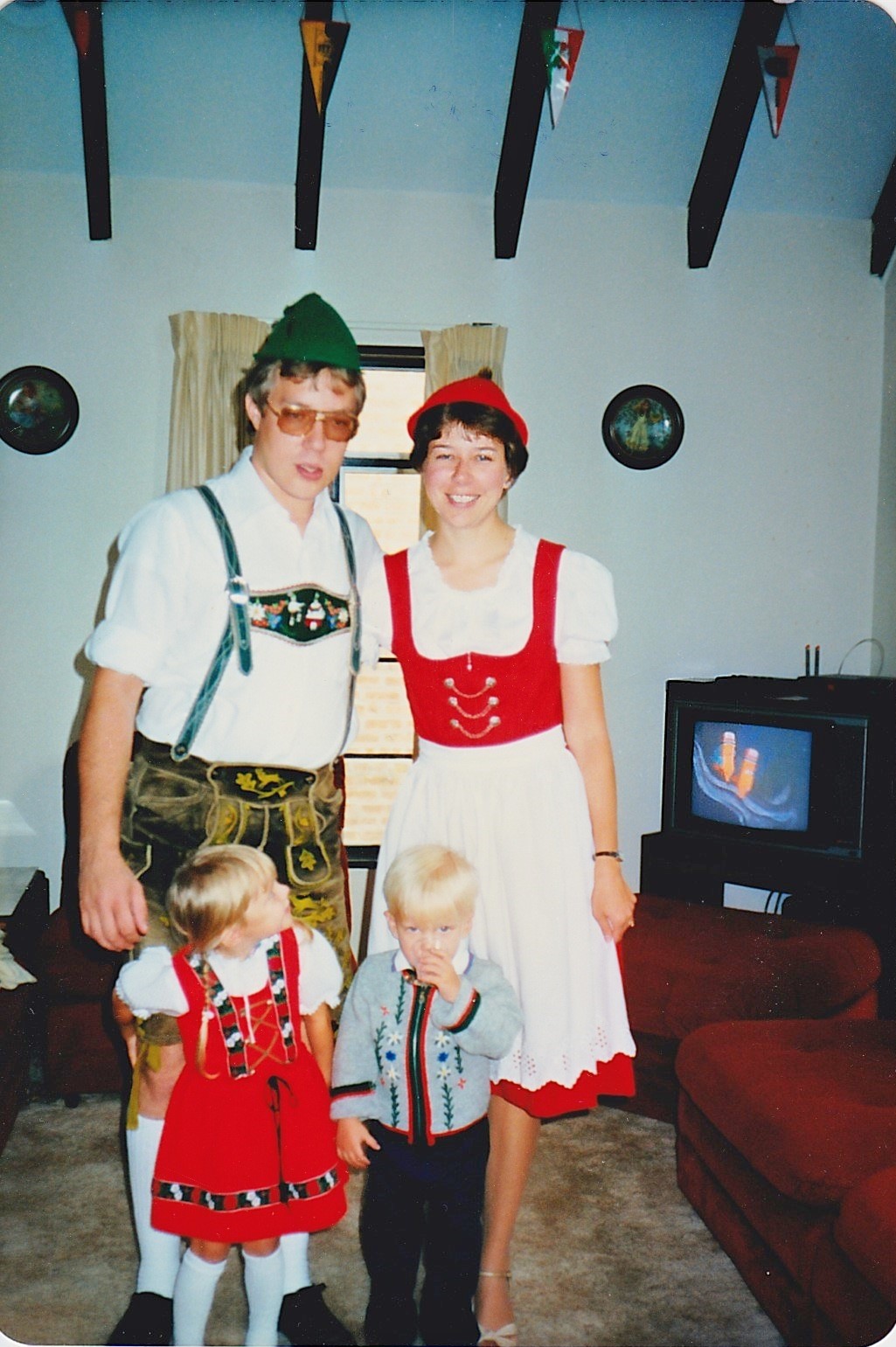
I chose to study German in high school and college, which probably seems like a pointless and illogical choice without context. Here’s the context: My Opa’s family had to escape a Russian prison camp during WWII when their little Austro-Yugoslavian town was invaded. My Oma’s mother spent a night in jail after she marched down to their Bavarian village’s school and forcibly removed the recently installed portrait of Hitler hanging in the hall. Oma also made Strudel and Krapfen that were unparalleled throughout the universe. When I was younger, my family would regularly dress in our finest–men in Lederhosen, ladies in Dirndls–and go down to the Edelweiss Club to polka and dance the Schuhplattler.
So, yeah… pretty German.
Opa also had a book about the history of his hometown, written in German. It was always my goal to read it, but I never got good enough at the language to do so, because apparently America sucks at teaching their children any language. The German exchange student I hosted in high school told me that over there, they pick their first foreign language in fifth grade and start taking classes, and add a second one when they get to our equivalent of high school. So she could speak fluent English, but I was still working with phrases like “the fish is in the toilet” (if I remember right, it’s “Der Fisch ist in der Toilette”).
I feel like, just maybe, this is somehow a contributing factor in why you never hear about any German kids eating Tide Pods.
Anyway, for most of my life, apart from singing the occasional Mozart, Brahms, or Mendelssohn, my German skills rusted on the metaphorical shelf of Things You Learn In High School But Never Actually Use. But over the past month, I’ve corresponded with Austria, Switzerland, and each of the sixteen individual German states, flailing about within my mind for words I haven’t had to use since my last German class roughly seventeen years ago, and compulsively checking my grammar against reputable sources.
It’s the second time, in my adult life, that this useless skill from high school has come in handy.
The first time was magical. You get to hear about it.
Back when I was still at Disney, Cogsworth had once again taken a metaphorical sledgehammer to my joints. Until my injuries healed, I couldn’t do my regular job, so I was given ‘light duty’–busy work, essentially. They assigned me to babysit one of the many children’s coloring tables scattered throughout Epcot at the time.
It was incredibly boring.
One day, a very distracted looking dad came up with his teeny, tiny little girl. The dad turned his back to the coloring table and began working intently on his phone. The little girl started coloring.
She was cute, so I made small talk. She would respond politely in a teeny, tiny voice–but the park was so loud, I couldn’t actually hear what she was saying. Which was fine—a large part of my job description was looking engaged and interested while small children babbled incomprehensibly at me.
We had quite a rapport built up by the time her dad took his attention away from his phone just long enough to turn his head back over his shoulder and say, “she doesn’t speak English.”
Ah. Well, in that case, I’ll go back to being bored and mute, then.
A bit of time passes in silence, the little girl busily coloring, when she stopped, handed me a crayon, pointed to her paper and said, louder than before and quite clearly, “Mach mir bitte einen Stern.”
I nearly jumped out of my seat. That was German! I can do that! I’d never had an opportunity to actually use the language I’d studied in school. Throughout my time in the parks I’d picked up a couple words of Portuguese and Japanese and some of what I referred to as ‘survival Spanish’ (“Por favor, abra su libro de autografos a una pagina blanca. Esto es la ultima familia de Mickey ahora. El esta de vuelta en el tres.”) but German had never actually been necessary. I frantically struggled to access archives within my brain that hadn’t been touched in almost a decade. ‘Make for me please a…’ Stern? What was Stern? A part of your face, right–forehead? Chin? No, that couldn’t be right.
“What does Stern mean?” I asked the dad.
“Star,” he replied, without looking up from his phone.
“Thanks.” Darn it, I should have known that one.
“She doesn’t speak English,” he added again.
“Yeah, it’s fine,” I said.
I drew a little five-pointed star on her paper. The little girl gave me a big smile.
A flood of “Mach mir bitte…” requests followed. “–Einen Herz.” I drew her a nice, big heart. “–Eine Blume.” I added a leafy daisy. “–Mich.” I doodled a stick figure little girl with pigtails, just like hers.
The little girl was delighted. Outside of the Germany pavilion and her own dad, I might have been one of few people in the park she could actually talk to.
“Ein Pferd.”
I paused. ‘Ein Pferd’ was a horse.
“…Ein Pferd?” I repeated, holding out my hands to indicate that a horse was really, really big.
“She doesn’t speak English,” her dad interjected over his shoulder again, irritably this time.
“I’ve got it,” I responded. I turned back to the little girl. “Wirklich (really)?” I asked. “Ein Pferd?”
She pinched her fingers together to indicate something very small. “Ein kleines Pferd.”
“Ah,” I repeated knowingly. “Ein kleines Pferd.” I drew my best attempt at a very small horse, next to my stick figure little girl. “Wie das (like that)?” I asked uncertainly, well aware that my artistic skill was probably lacking. But apparently it was satisfactory–the little girl nodded in approval.
The dad was finally finished on his phone. He stood up, annoyed, took his daughter by the hand and began to lead her away. She turned back to wave goodbye.
“Tschüss!” I called. It’s German for goodbye, but you’d really only know that if you weren’t a complete noob at German.
The dad did a double take.
So, for what everyone told me was a useless language to study, that’s twice in my life now that it’s come in handy. No regrets.
 Laura Writes
Leave a comment