
I felt pretty lucky, growing up, because most kids just had grandmas, but I had a grandma AND an Oma.
Not to say that one is better than the other. To be clear, Oma is German for Grandma. But the distinction felt necessary to me. It was a completely different job, and it required a different title.
Feisty
Sometimes, I need to remind myself that I inherited the DNA of a lot of feisty women.
Oma was born, and grew up, in a teeny, tiny village in Bavaria in the 1930s.
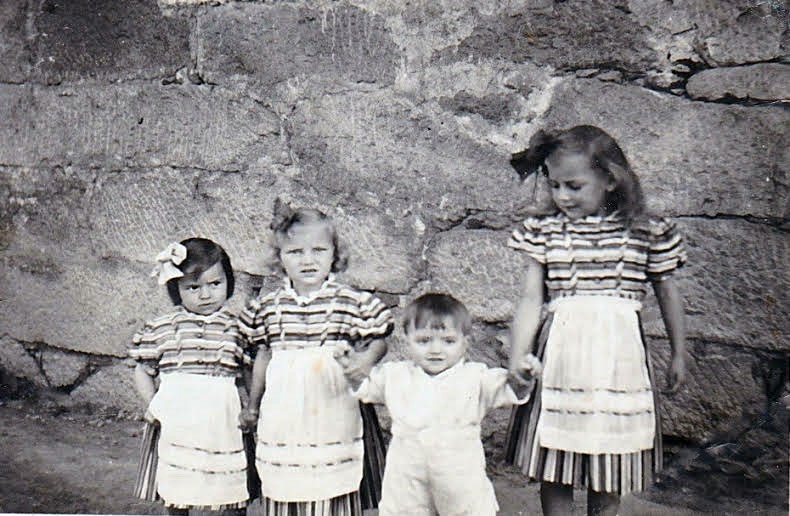
One of my absolute favorite things to know about my family is that one day, the local school in Oma’s tiny town took the portrait of Jesus off display and replaced it with a picture of Hitler. My great grandmother—Oma’s mom—marched down to the school, took Hitler down, and put Jesus back up. She got arrested and spent a night in jail for that.
Lest you think that my sweet, smiling, diminutive Oma didn’t inherit that defiant, independent streak, in 1950, when Oma was 17, she immigrated to America entirely by herself. Over time, she saved up money to bring over her mother and all of her siblings.

Oma’s feisty, stubborn side showed up in the way she’d gently smack my dad with a slipper or a wooden spoon when he teased her, or that time she broke her foot while trying to hang up Christmas decorations and went to Baker’s Square for dinner instead of the hospital because she couldn’t be injured; there was too much Christmas-prepping to do. (The family wrote an entire song parody about it: “Oma’s Got a Broken Foot this Christmas…”)
Of course, my favorite Feisty Oma moment was when she and Opa got a Nintendo Wii, because Oma became a Wii Shark.
Oma loved Wii Sports. Like, really loved it. She played every day. When you came by to visit her, she would innocently say, “Would you like to play the Wii?” (Although, with her Bavarian accent it was pronounced ‘Vii’.) Then she would proceed to absolutely destroy you in Wii Bowling, smile at you nonchalantly, and announce that she won.
True Love

Opa (my grandfather) used to say, “It all started when a shy boy asked an even shier girl to dance.”
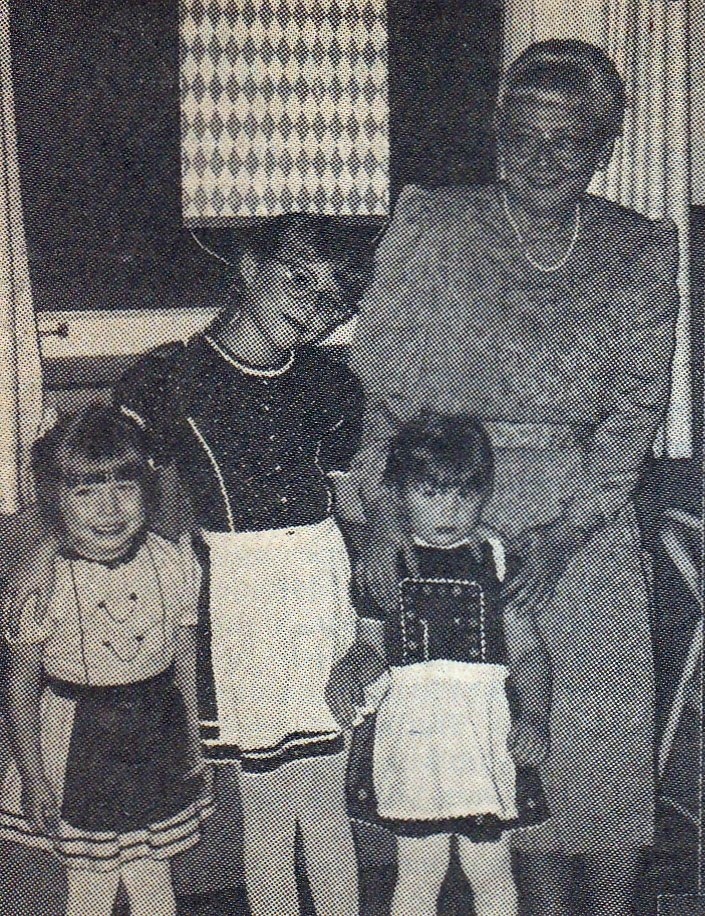
Oma may have come to America alone, but she quickly found a support group here of other German-Americans, some of whom remained her friends for the rest of her life. She joined a local society of other people of German heritage, and took advantage of the frequent social events they hosted, where they danced to waltzes, polkas, and the Schuhplattler, which…you know what, maybe it’s better if I just show you.
(Yes, Oma did the spinny-skirt thing. We used to attend these dances every year when I was a kid—sometimes, one of Oma’s sisters would be performing!)

One night, a handsome, green-eyed young man watched her perform and later asked to dance the Blue Skirt Waltz with her, and it was true love. Their first date was the next evening, and three years later they were married.

Everyone in our local community knew Oma and Opa—maybe not by name, but as ‘the sweet couple that’s always holding hands’. Every Sunday, as they walked into church, they would enter hand in hand. Whenever Opa looked at Oma, it was with a brilliant, adoring smile. I think they served as a pretty powerful relationship goal—not just for their children and grandchildren, but for the whole neighborhood.
Magical
You know that scene in Sleeping Beauty where the three fairies are cheating, and using their magic wands to clean and bake?
Well, I never found Oma’s magic wand, but you’ll never convince me she didn’t have one.
Growing up, every Saturday, the whole family would meet at Oma’s house for lunch, and quite often, many of us would stop in on Sundays after church for brunch as well. Oma was delighted to feed her family, whether it was fresh-baked cinnamon rolls, eggs made to order, homemade cream of chicken soup, lunch meats and cheeses from the German deli, or just several pounds of bacon.
Here’s the thing: at Oma’s house, there was no need for the five-second rule. Her floor—in fact, her whole house–was, somehow, always spotlessly clean. If you dropped some food, which was easy to do with 30-some people eating lunch in a crowded kitchen, everyone would just shrug, remind you that “it’s Oma’s house,” and you’d eat it anyway.
And somehow, there was never a shortage of delicious baked goods.
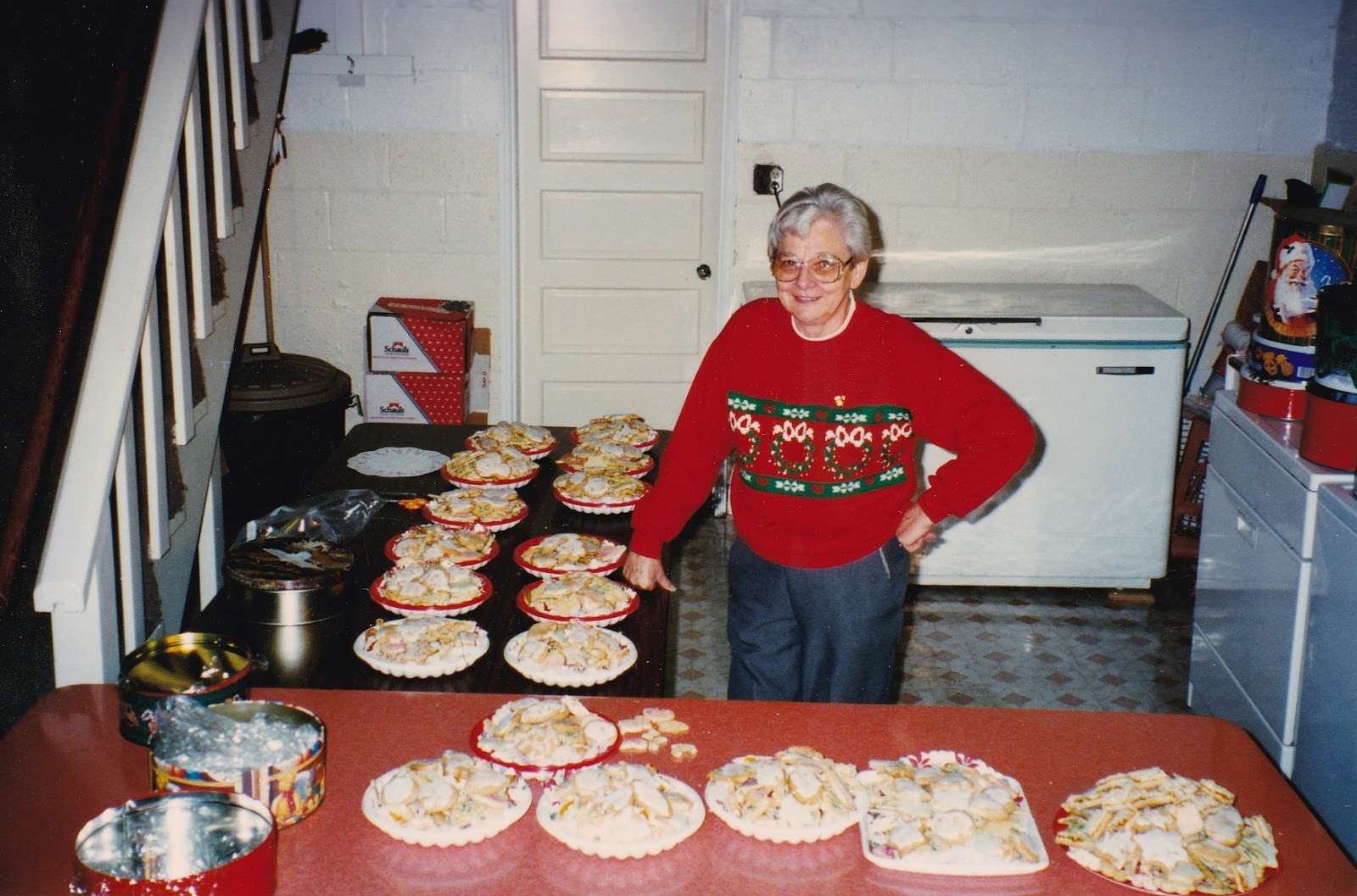
One of the reasons everyone in the neighborhood knew Oma was for her legendary baking. If there was a bake sale, you bet Oma contributed, and her stuff was the first to go. At holidays, she would drop off plates of cookies for the staff at the church and the local school.
Oma’s cookies were fantastic, but a challenge to replicate, because she didn’t use recipes. To replicate her honey cookies—her most famous creations—one of my aunts had to actually watch her bake and keep stopping her to take measurements. Oma would say, “and then I take this cup and I fill it to about here with flour,” and my aunt would have to grab it before she dumped it into the bowl and determine that it was seven eighths of a cup, or something similar.
Honey cookies were a coveted prize, and Oma knew the importance of always having an emergency supply around. The basement freezer was always stocked with Ziploc bags full of honey cookies. If you were planning a road trip, you could be assured that Oma would hand you a bag of honey cookies for snacking during the car or plane ride. There would always be a plate of them at every special occasion. And if your friends happened to drop by unexpectedly, they would get a bag as well.
The other thing Oma kept an emergency supply of–and handed out readily, as needed–were Lindt chocolate bars. There was always a stack of about ten of them in her kitchen cabinet in case the situation warranted chocolate, and at Saturday lunches we’d usually break one or two open and take a few squares each. As oldest grandchild, I was one of few people with standing permission to initiate that procedure.
The problem with having a magic wand-wielding Oma is that it’s turned most of us into Strudel Snobs. Oma’s strudel was the best thing on the planet, and none of us have ever been able to satisfactorily replicate it. I have never, ever tasted strudel anywhere else that was a sufficient stand-in for Oma’s. As a result, many of us now refuse to order strudel anywhere, ever, because we know we’ll be disappointed.
Oma’s house was everybody’s house. Everyone was welcome, and everyone who came through the door was treated like family. But Oma’s warm, welcoming nature extended beyond the threshold of the house. Oma seemed to make friends everywhere she went–whether power-walking around the mall or standing in line at a theme park. By the time she was done eating at a restaurant or checking out at the grocery store, she and the server or cashier were old buddies (and you could be sure that she would brag about her sixteen wonderful grandchildren).
There’s no word for my Oma’s warmth and love except ‘magical’.
Bleeding Cubby Blue
Being born into Oma’s family meant you were raised German, Catholic, and a Cubs fan.
Oma went to her first Cubs game in 1951, and she was a diehard fan ever after. She and Opa would travel to Arizona for Spring Training every year, and always managed to get tickets to the Cubs Convention. If she wasn’t in the stands at the game, she would be in her living room, hooting, hollering and yelping at each play as she watched on the big screen TV that Opa bought her “so she could see the Cubs better”.

Oma definitely got feisty at anyone who disparaged her beloved Cubbies. My friend’s father, a tall, lanky Irish fellow, was a Sox fan, and he LOVED to mess with her about it. When they ran into each other at neighborhood gatherings, he’d usually sneak in some sly remark about how the Cubs had been playing that week, and Oma would lightly smack him on the arm and tell him to be quiet.
One of his daughters recently recalled a gathering where Oma stormed up to him right as he walked in the door once, smacked him on the arm, and said, “You be quiet!” Immediately.
“I didn’t even say anything!” He protested.
“I knew what you were thinking!” Oma retorted.
In 2016, during the leadup to the fateful World Series that would see the Cubs win the championship for the first time in 108 years, many Chicagoans went down to Wrigleyville to write good luck messages in chalk on the walls of the Friendly Confines. My dad and sister went down there and wrote, “Win for Oma!” I definitely believe that’s why they won.
Mistress of Mischief
Oma was a troublemaker.
Sure, she LOOKED sweet and innocent. That doesn’t change the fact that she taught every one of her grandkids to shoot straw wrappers at people, blowdart style, whenever they opened a straw.
Every summer around Fourth of July, Oma and Opa would host a barbecue in their backyard. (Which, seriously, magic wand. How many other people do you know who had several perfectly manicured rose bushes surrounding their house?)
The highlight of the barbecue was the great water fight. Everyone would arm themselves with Super Soakers, and Oma would provide a giant cooler full to the brim with water balloons, at which point no one who stepped on the grass was safe. The battle would rage across the whole property, but everyone knew that the porch and the pavement were Dry Zones; no one in those areas was okay to soak.
Of course, if Oma makes the rules, she’s the only one allowed to break them. That’s why it always surprised everyone and no one that she kept a secret stash of water balloons out of the pile for her own, personal use, and at the right moment in the Water War, she would change the tide of battle with a surprise barrage from the back porch, where no one was allowed to retaliate.
In the winter, anyone entering the house could expect the same treatment with a flurry of snowballs. One year, Oma very deviously saved a pile of snowballs in the freezer for MONTHS so that she could ambush unsuspecting relatives in June.
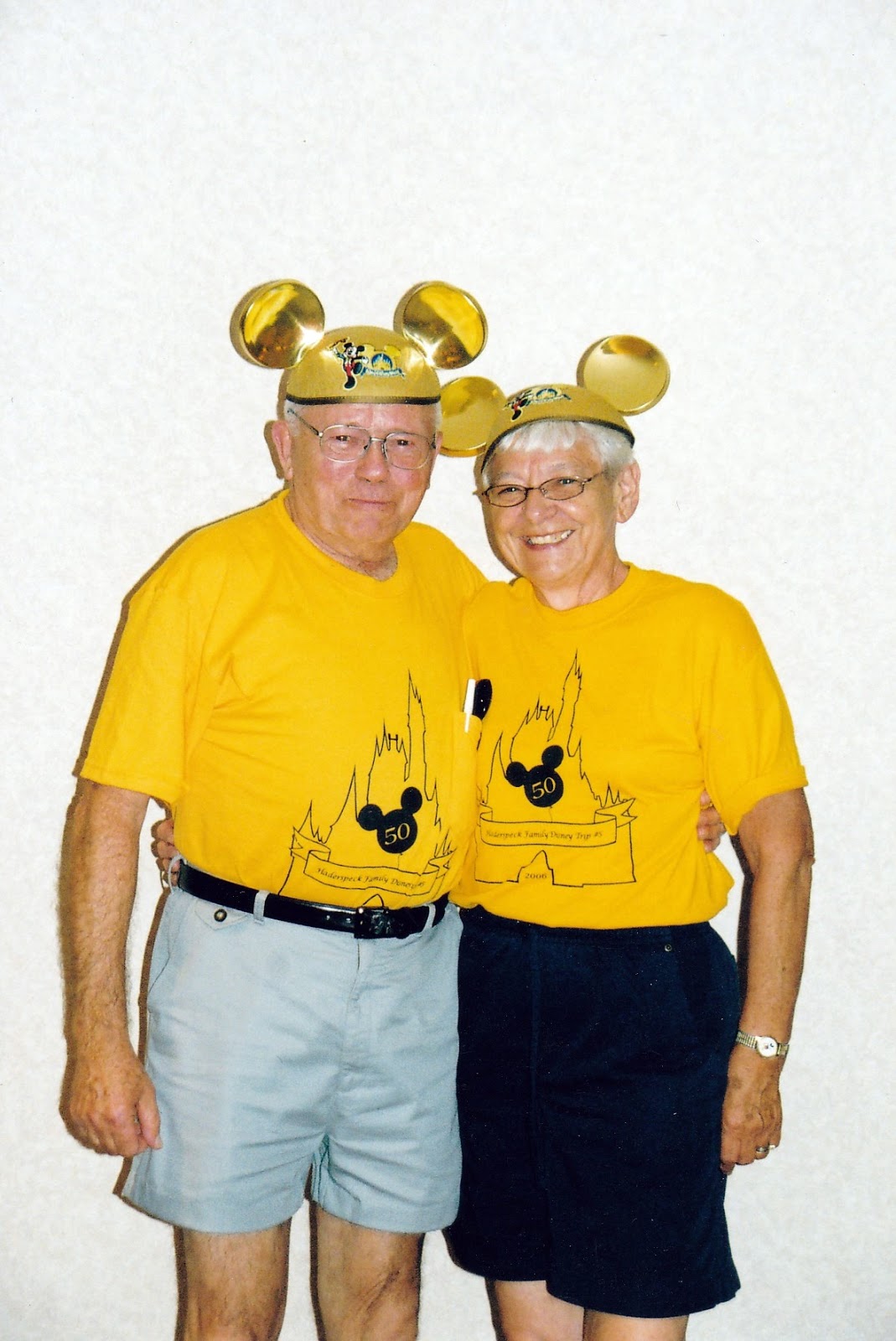
It’s important to note, somewhere in this post, that Oma and Opa loved Disney. Their philosophy (which my other grandmother adopted as well) was that they wanted us to enjoy our inheritance from them while they were alive to see it, so every few years, Oma and Opa would take the whole family (~30 people) on a Disney vacation together.

In case you’re wondering what kind of mischief an Oma could get up to at Walt Disney World: one time, when my family of five was taking a Disney vacation of our own, Oma and Opa secretly booked their own trip without telling us. Oma snuck up behind me in the food court and just chirped, “Howdy!” At first I just turned around and acknowledged her…then I did a double take as I realized we hadn’t brought her with us. She snickered about the look on my face for hours.

*****
My aunts and uncles were all at work when they heard that Oma would be leaving us soon. They all immediately made arrangements to be there with her, but her oldest daughter–her namesake, Karol–was coming from 45 minutes away. Once most of her children had gathered and were holding vigil with the hospice nurse, Oma stopped breathing for about 30 seconds.
My godmother said, “Not yet, Mom! Wait for Kar!”
As loving–and stubborn–as ever, Oma started breathing again.
Everyone hoped that Oma would wait until all her children were around her, but although the hospice nurse smiled kindly, it was clear she didn’t hold out much hope. Once a patient stopped breathing once, it was usually only fifteen or twenty minutes more.
As the minutes stretched by, the rest of Oma’s children and sons- and daughters-in-law began arriving one by one. They each gave Oma a kiss on the cheek and said, “I’m here, Mom, but if you can hang on a little bit longer, try to wait for Kar.”
For 45 more minutes, my stubborn Oma held on until all of her children could be with her. Finally, she heard, “It’s Kar. I’m here, Mom. We’re all here now.”
A few minutes later, she went to join her true love in heaven.
*****
It took me much longer to write this than I wanted; partly, because I wanted to capture here the memories that the rest of my family shared over the past few days. My cousin Melissa gave a beautiful eulogy that perfectly captured Oma’s spirit, and a few of the things I wrote about here I would not have remembered if she hadn’t reminded me.
Mostly, though, this post took so long because I wasn’t sure how to finish it. I decided to end it this way:
If you have a few dollars to spare, and you’d like to donate to https://www.alz.org/ in memory of Karolina Haderspeck, my family would appreciate it, and so would many, many others.
 Laura Writes